
Foundation repair puts a house back on stable ground after the soil beneath it has moved. In Birmingham that movement is not unusual or unlucky — it is what our soil does. The red clay across Jefferson and Shelby Counties swells when it takes on water and shrinks back when it dries out, and a house sitting on top of that is lifted and dropped by fractions of an inch, season after season, until something in the structure gives.
Why Birmingham Homes Move
Most of the metro sits on clay with a high shrink-swell potential. We get somewhere around fifty-four inches of rain a year, usually in bursts, separated by hot dry stretches in late summer. That cycle is close to the worst case for a clay soil: saturated in March, baked hard in August, and the ground under your slab or piers changes volume between the two.
Terrain makes it worse in places. Birmingham is a ridge-and-valley city — Red Mountain, Shades Mountain, Jones Valley — so a great many houses sit on cut-and-fill lots where part of the footprint rests on undisturbed ground and part rests on fill that was never compacted to the same density. Those two halves settle at different rates. That is why so much local damage shows up on one corner or one wall rather than evenly around the house.
Signs You Have a Foundation Problem
Doors and windows that used to work and now stick, or that swing open on their own, are usually the first thing people notice. Diagonal cracks running out from the upper corners of door and window frames are a common companion, because that is where a wall racks first when a corner drops.
Look for gaps opening between crown molding and the ceiling, or between baseboard and floor. Check whether floors slope — a marble is a crude test but a real one. Outside, look for stair-step cracking in brick veneer or block, gaps where the brick meets a window frame, and chimneys pulling away from the wall.
In houses with crawl spaces, the tell is often underneath rather than inside: piers leaning, shims fallen out, girders sagging between supports, or a musty smell that has appeared in the last year or two.
What Actually Gets Done
The repair depends on what moved and why, which is why an inspection comes before a price rather than after it.
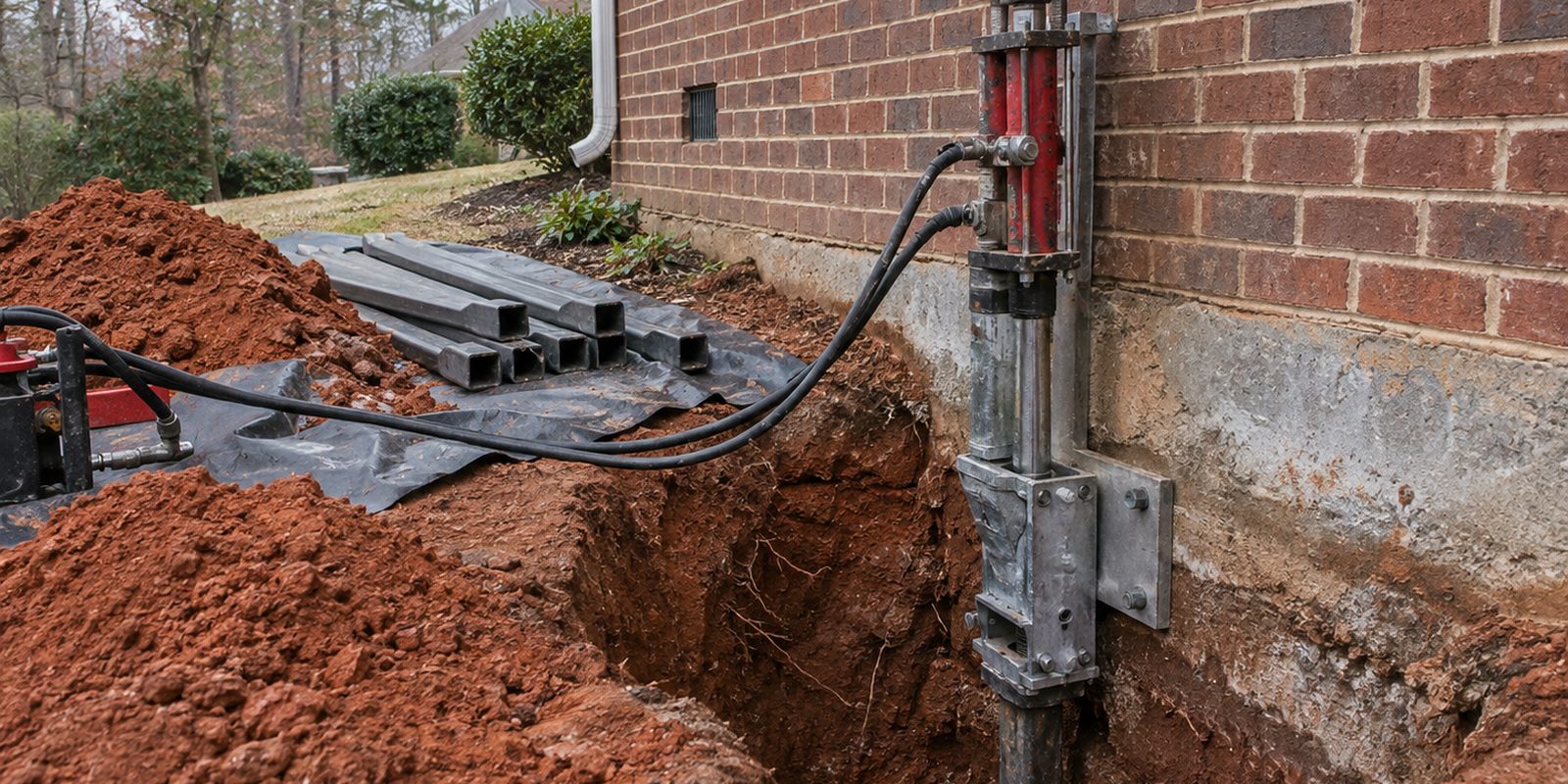
Where a footing has settled, the usual answer is underpinning: steel piers driven or screwed down through the unstable clay to competent soil or bedrock, then the load of the house transferred onto them. Push piers use the weight of the structure to drive them; helical piers screw in and are often chosen where the load is lighter. Once the piers are carrying the house, the affected section can usually be lifted back toward its original elevation, though how far is a judgment call rather than a guarantee.
Where a crawl space has settled, the fix is often simpler and considerably cheaper — new footings and adjustable steel jacks under the girders, replacing failed masonry piers and rotten shims.
Where a block wall is bowing inward from lateral soil pressure, the answer is wall anchors or carbon fiber straps rather than piers, because the wall is being pushed, not dropped.
What It Is Reasonable to Expect
An honest contractor will tell you that lifting a settled house back to dead level is not always achievable and not always wise. Pushing too hard can open new cracks in finishes that have long since adjusted to the current position. The goal is normally to stabilize the movement first and recover as much elevation as the structure will take without damage.
You should also expect the repair not to include cosmetic work by default. Piers stop the movement; patching drywall, repointing brick and re-hanging doors are usually separate.
Getting an Answer on Your House
Send photographs if you can — a wide shot of the affected wall inside and out, a close-up of any crack with something for scale, and a picture of the crawl space if you can safely reach it. It is often possible to say from photographs whether you are looking at settlement, lateral pressure, or ordinary curing cracks that need nothing done at all.
If the honest answer is that your house does not need structural work, you should be told that too.